

How Do Dogs and Puppies Recognize Their Names? The Science Behind It
Have you ever called your dog by name and watched their ears perk up, their tail start wagging, or their head tilt to one side?
It’s an adorable moment, but have you ever wondered what’s actually happening inside your dog’s brain?
Do dogs really know their names, or are they simply responding to the sound of your voice?
The answer is more interesting than you might think.
Dogs and puppies can learn to recognize their names through a combination of sound recognition, memory, repetition, and positive experiences. But recognizing a name isn’t quite the same as understanding a human name.
In this guide, we’ll explore how dogs recognize their names, when puppies begin learning them, why some dogs ignore their owners, and how you can help your puppy respond more reliably.
You’ll also find a simple name-recognition activity you can try at home.

1. Do Dogs Really Know Their Names?
Yes! Dogs can learn to recognize their names as familiar, meaningful sounds.
However, dogs probably don’t think about names in exactly the same way humans do.
When someone says “Charlie,” a person understands that Charlie is an individual’s name.
A dog learns something slightly different.
For example, a puppy named Charlie might learn that hearing “Charlie!” means:
- Someone wants their attention.
- Something interesting might happen.
- Their owner may offer a treat.
- It’s time to play or interact.
- They should look toward the person speaking.
Over time, the puppy connects that particular sound with familiar experiences.
This process is called associative learning.
A simple example
Imagine you have a puppy named Milo.
Every morning, you say “Milo!” in a cheerful voice before giving him breakfast.
Later, you say “Milo!” before playing with his favorite toy.
After enough positive experiences, Milo begins paying attention whenever he hears that sound.
He has learned that his name is worth listening for.
The important difference: Recognizing a name means identifying a familiar sound. Coming when called is a separate skill that requires additional training.
2. How Does a Dog’s Brain Recognize Its Name?
Dogs are remarkably good at noticing sounds in their environment.
They can hear frequencies beyond the range of typical human hearing and are sensitive to changes in pitch, rhythm, and vocal expression.
But excellent hearing alone doesn’t explain name recognition.
Three important learning processes help dogs recognize their names.
Sound recognition
Dogs can learn to distinguish familiar spoken sounds from unfamiliar ones.
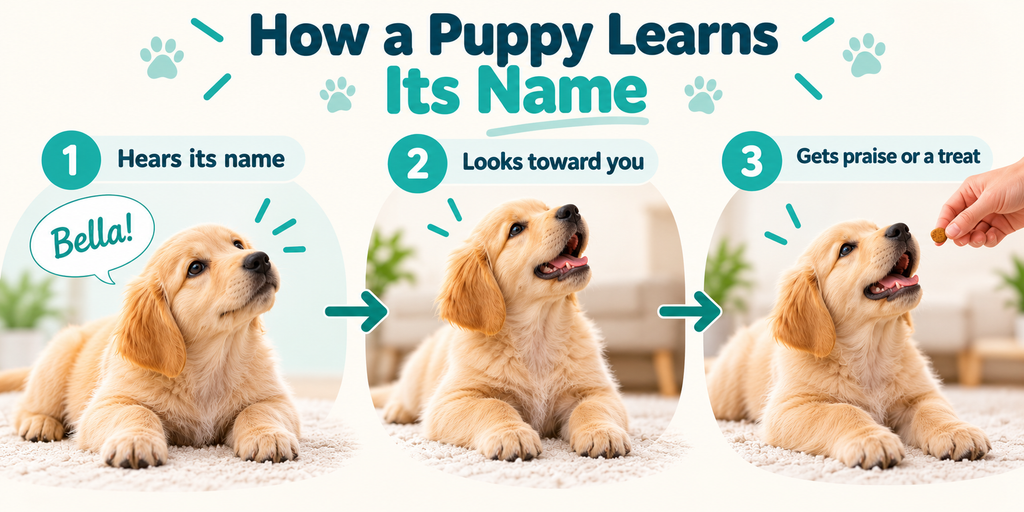
Your puppy may gradually recognize the sound pattern of “Bella” even when you say it during an ordinary conversation.
Memory and association
When your puppy repeatedly hears their name during positive interactions, the sound becomes familiar and meaningful.
For example:
“Bella!” → Puppy looks at you → You reward her.
Repeated practice strengthens that association.
Emotional tone and context
Dogs pay attention to how people speak.
Research suggests dogs process both words and vocal intonation, and these elements can influence their responses.
A cheerful “Bella!” may encourage your puppy to approach, while an angry voice may make her hesitant.
That’s why it’s important to make your dog’s name a positive signal rather than something associated with punishment.
3. Do Dogs Recognize Their Names or Just Your Voice?
This is a fascinating question.
Dogs can learn information from both the words we say and the voices saying them.
For example, a dog may recognize their owner’s voice even when they cannot see them.
Research published in NeuroImage in 2016 found that dogs process meaningful words and vocal intonation in different ways, suggesting their response to human speech is more sophisticated than simply reacting to noise.
However, this doesn’t mean every dog understands their name independently of context.
A dog may respond differently depending on who is speaking, where they are, and what they expect to happen next.
Try this simple experiment
Ask two family members to help.
- Sit with your puppy in a quiet room.
- Have one person say the puppy’s name once.
- Watch whether the puppy turns or looks toward the speaker.
- After a short break, have the second person repeat the exercise.
- Compare the responses without forcing the puppy to react.
You may discover that your puppy recognizes their name from more than one person.
Keep the activity relaxed, and reward attention without repeatedly calling the name.
4. At What Age Do Puppies Learn Their Names?
Puppies can begin learning their names when they’re young, especially once they’re comfortable interacting with people.
There isn’t one exact age when every puppy suddenly understands their name.
Some puppies begin responding after several short training sessions, while others need more time.
Their progress depends on several factors:
- Age and developmental stage.
- Previous experiences with people.
- Consistency of name use.
- Training environment.
- Distractions and excitement.
- Individual personality.
How long does it take?
A puppy may begin showing recognition within days of consistent practice.
However, developing a reliable response in different environments can take several weeks or longer.
A realistic goal is to practice consistently over 30 days, without expecting every puppy to master the skill on the same schedule.

5. Why Does My Dog Ignore Its Name?
One of the most common questions dog owners ask is:
“My dog knows its name, so why does it sometimes ignore me?”
The answer is that recognition and response are two different things.
Your dog might recognize its name perfectly well but still be more interested in something else.
Here are some common explanations.
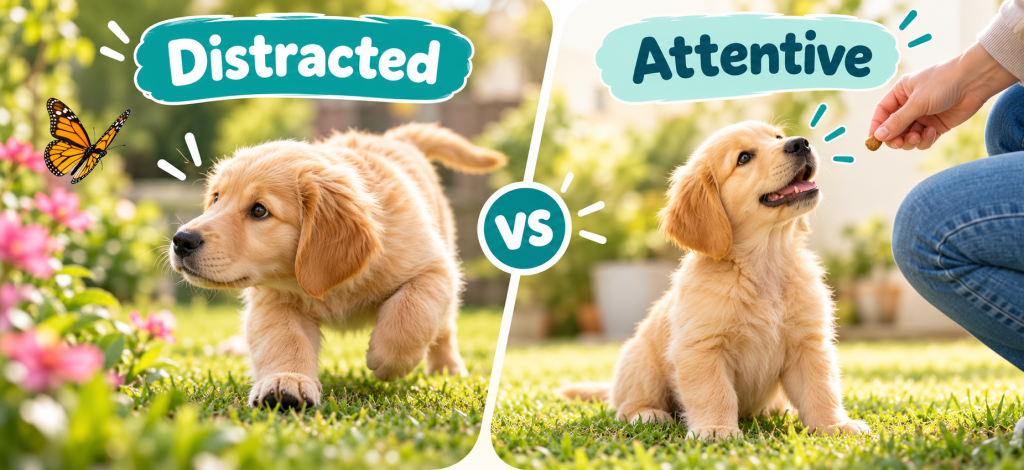
Your dog is distracted
Imagine your dog is exploring an exciting new park.
There are unfamiliar smells, other dogs, moving people, and interesting sounds everywhere.
Your voice may simply be competing with more exciting stimuli.
You’ve repeated the name too often
If you say “Max, Max, Max, Max!” without anything meaningful happening, your dog may become less responsive.
Instead, say the name once, wait briefly, and reward your dog when they pay attention.
If they don’t respond, make the next attempt easier by reducing distractions.
Your dog associates its name with negative experiences
If you frequently shout your dog’s name before scolding them, they may become reluctant to respond.
Try using their name during pleasant experiences such as playtime, gentle praise, and reward-based training.
Your dog hasn’t practiced in different places
A puppy that responds beautifully in the living room may struggle in the garden.
This is normal.
Dogs need opportunities to practice learned behaviors in different environments.
There may be a hearing or health issue
If your dog suddenly stops responding to familiar sounds, especially alongside other changes in behavior, consult your veterinarian.
6. How to Teach Your Puppy to Recognize Its Name
You don’t need expensive equipment or complicated training techniques.
A quiet room, a few small treats, and a little patience are enough to get started.
Step 1: Choose one name
Pick a name that your family can pronounce comfortably.
Short, distinct names can be convenient, but longer names can work too.
Avoid constantly switching between several nicknames during the earliest stages of training.
Step 2: Start somewhere quiet
Begin in a familiar room with minimal distractions.
Keep your puppy close enough to hear you easily.
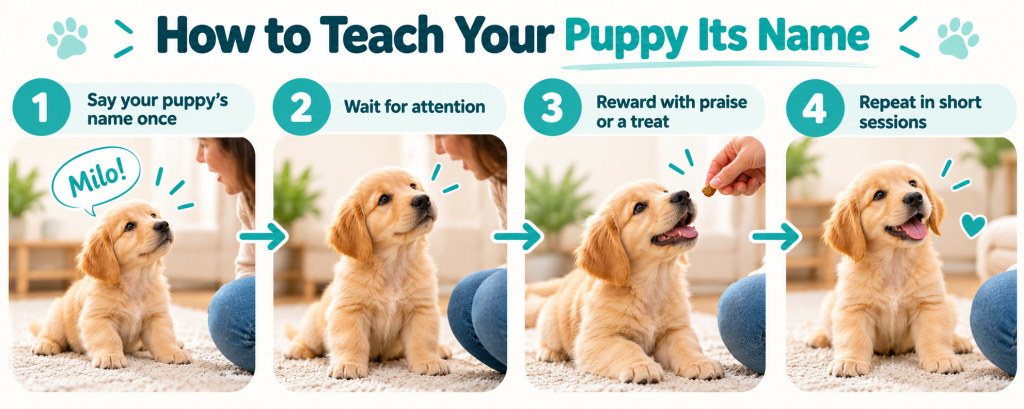
Step 3: Say your puppy’s name once
Use a warm, friendly voice.
For example:
“Milo!”
Don’t immediately repeat it if your puppy doesn’t look.
Step 4: Reward attention
When your puppy turns toward you or makes eye contact, immediately offer praise or a small treat.
The goal is to teach:
Hearing my name → Paying attention → Something good happens.
Step 5: Keep sessions short
Try practicing for one to three minutes at a time.
Several short sessions can be more manageable for a young puppy than one long lesson.
Step 6: Gradually introduce distractions
Once your puppy responds in a quiet room, practice in other familiar locations.
Eventually, try a calm outdoor environment.
Increase the difficulty gradually, and return to easier practice whenever your puppy struggles.
Remember: Name recognition is an attention exercise, not a substitute for recall training.
7. A Simple 30-Day Puppy Name Training Plan
Every puppy learns at their own pace, but a structured routine can help you stay consistent.
| Days | Training focus | Your goal |
|---|---|---|
| 1–5 | Name recognition in a quiet room | Build a positive association |
| 6–10 | Rewarding eye contact | Encourage attention |
| 11–15 | Practicing with family members | Respond to different voices |
| 16–20 | Practicing in different rooms | Recognize the name in new settings |
| 21–25 | Introducing mild distractions | Improve focus |
| 26–30 | Reviewing skills in safe environments | Build more consistent responses |
This plan is a flexible guide, not a guarantee.
If your puppy struggles with a particular stage, spend extra time practicing before moving forward.
8. Five Common Mistakes When Using Your Dog’s Name
Even well-meaning owners sometimes make name training harder than necessary.
Mistake 1: Repeating the name constantly. Saying the name over and over without a meaningful interaction can make it less useful as an attention cue.
Mistake 2: Using the name mainly when angry. Your puppy may begin associating their name with unpleasant experiences.
Mistake 3: Expecting instant results. Young puppies are still developing their attention and learning skills.
Mistake 4: Training only inside the house. Dogs need gradual practice in different settings to respond reliably.
Mistake 5: Confusing name recognition with recall. Knowing their name doesn’t automatically teach a puppy to run toward you.
For reliable recall, teach a separate cue such as “Come” and reward the behavior consistently.
9. Can Dogs Learn More Than One Name?
Yes, dogs can learn multiple spoken cues.
A dog might respond to its official name, a nickname, and familiar expressions used by family members.
For example, a dog named Theodore might also learn to respond to “Teddy.”
However, if you’re teaching a new puppy its name, beginning with one consistent name is usually easier.
Once your puppy understands the first name, additional nicknames can be introduced naturally.
10. Can Dogs Recognize Other Dogs’ Names?
Some dogs may learn to associate particular words with other dogs, people, toys, or activities.
For example, a dog might become excited when hearing the name of another dog they regularly play with.
However, reacting to a familiar name doesn’t necessarily mean the dog understands names as labels in the same way humans do.
Dogs may also use context, tone, and previous experiences to interpret what a word predicts.
The important point is that dogs are capable of learning meaningful associations with many different sounds.
11. Free Printable: My Puppy Knows Their Name!
Want to turn name training into a fun daily activity?
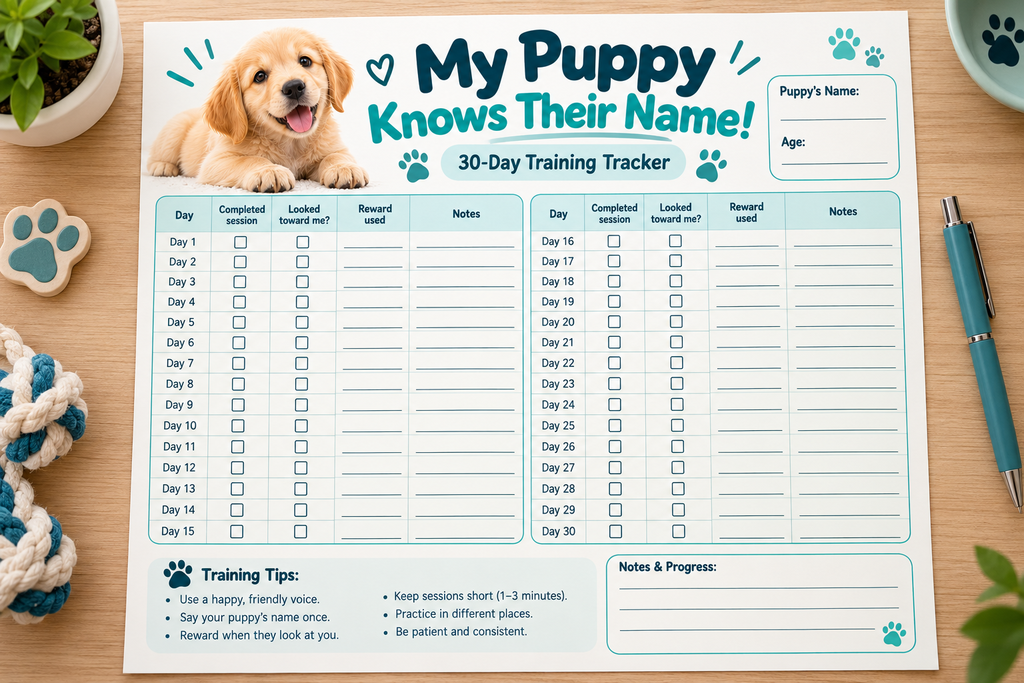
Use a simple printable progress tracker to record your puppy’s training sessions.
What to include in your tracker
- Your puppy’s name and age.
- The date and training location.
- A checkbox for completing the session.
- Whether your puppy looked toward you.
- The reward you used.
- A space for notes and progress.
How to use it: Practice a few times each day, then record one brief summary of how the session went.
Don’t worry if some days are more difficult than others. Progress isn’t always perfectly consistent.
Download the Free 30-Day Puppy Name Training Tracker
How to print
- Download the printable PDF.
- Open it on your phone, tablet, or computer.
- Choose A4 or US Letter paper, depending on the available version.
- Select actual size or 100% scale.
- Print and start tracking your puppy’s progress.
Frequently Asked Questions
Do dogs understand that their name belongs to them?
Dogs can learn that a particular sound is directed toward them and predicts interaction. However, we cannot assume they understand personal identity or names in the same conceptual way humans do.
Why does my puppy tilt its head when I say its name?
Head tilting may be related to attention, sound processing, or attempts to interpret familiar communication. It doesn’t necessarily mean the puppy is confused.
Can an older dog learn a new name?
Yes. Adult and senior dogs can learn new names through consistent, positive associations. The time needed varies from dog to dog.
Should I change my rescue dog’s name?
You can change a rescue dog’s name if needed. Introduce the new name gently, pair it with positive experiences, and allow time for adjustment.
Why does my dog respond to my voice but not strangers?
Your dog may be more familiar with your voice, tone, and routine. Practice with other trusted people can help your dog learn to respond to its name when spoken by different voices.
Does my dog know its name when it’s sleeping?
Dogs can detect some sounds while resting, but whether a sleeping dog responds depends on its sleep stage, the sound, and other factors. Avoid repeatedly waking your dog just to test name recognition.
Final Thoughts: Your Dog’s Name Is More Than Just a Word
When your puppy hears its name and looks toward you, something meaningful is happening.
Through experience, memory, and positive interactions, your dog has learned that a particular sound deserves attention.
It’s a small but important part of communication between people and dogs.
The best way to strengthen that connection is simple: use your dog’s name consistently, reward attention, and practice patiently.
Whether you have a playful new puppy or an older dog learning a new name, every positive interaction is an opportunity to build communication and trust.
And next time your puppy looks up when you say their name, remember that you’re seeing a learned connection in action.
More Ways to Enjoy Life with Your Dog
Discover helpful dog-naming guides, creative inspiration, and thoughtful finds for dog lovers.
More Dog Name Inspiration
Explore more guides and ideas to help you find the perfect name for your best friend.
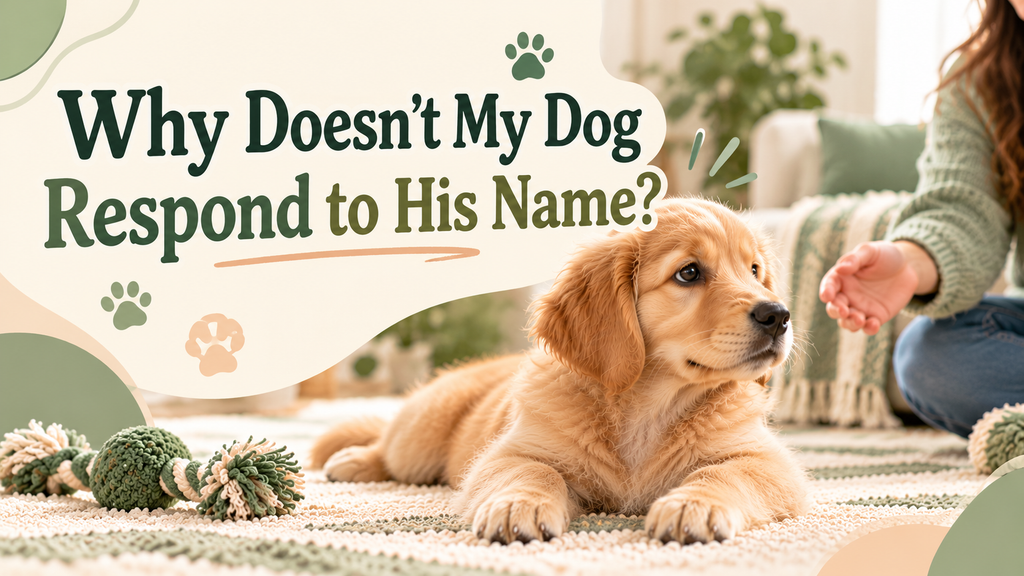
Why Doesn’t My Dog Respond to His Name? 9 Reasons & How to Fix It
Why Doesn’t My Dog Respond to His Name? 9 Reasons & How to Fix It You call your dog…
Read Article
How to Teach a Puppy Its Name: Easy Steps + Free 30-Day Training Tracker
How to Teach a Puppy Its Name: Easy Steps + Free 30-Day Training Tracker You’ve finally chosen the perfect…
Read Article
Dog Name Lab
Explore name ideas, discover different naming styles, and find inspiration for your dog’s perfect name.
Explore Name Lab
The Olei Shop
Discover dog-inspired products, thoughtful gifts, and fun finds for you and your four-legged companion.
Explore the Shop