

How to Use Your Dog’s Name Correctly: 4 Smart Training Tips
Your dog’s name is more than something you call across the living room. It’s one of the most useful communication tools you have.
But here’s something many dog owners don’t realize: the way you use your dog’s name can affect how quickly and reliably they respond to you.
Have you ever called your dog five times while they continued sniffing the grass, playing with a toy, or looking in the opposite direction?
You might think your dog is ignoring you on purpose. But sometimes, the problem is how they’ve learned to respond to their name.
The good news? A few simple changes can make a difference.
In this guide, we’ll explore four practical ways to use your dog’s name more effectively, build positive associations, and make everyday communication easier.
You’ll also find a free printable dog name training checklist to help you practice at home.

Why Your Dog’s Name Matters
Dogs don’t understand names exactly the way humans do.
Instead, they learn to associate familiar sounds with experiences, actions, and consequences.
For example, when you say “Bella” and your puppy turns toward you, you might offer a treat, smile, or begin a fun game.
Over time, Bella can learn that hearing her name means paying attention to you is worthwhile.
But the opposite can happen, too.
If your dog mostly hears their name when you’re frustrated or angry, they may begin associating that sound with unpleasant experiences.
That’s why teaching your dog to recognize their name is only the beginning.
The real goal is to help your dog feel good about responding to it.
1. Never Use Your Dog’s Name as a Punishment
Imagine your puppy Max has just grabbed your favorite shoe.
You shout:
“MAX! MAX! BAD DOG!”
It might feel natural in the moment, but repeatedly using your dog’s name during angry interactions can create an unwanted association.
Instead of thinking, “My owner needs my attention,” Max may begin expecting something unpleasant.
What should you do instead?
Use your dog’s name in a friendly tone to get their attention, and teach separate cues for specific behaviors.
For example:
| Situation | Better approach |
|---|---|
| Your dog grabs a shoe | Calmly cue “Drop it” if trained, then reward releasing it |
| Your puppy approaches something unsafe | Use a trained “Leave it” cue and intervene |
| Your dog jumps on guests | Reward four paws on the floor |
| Your dog comes when called | Praise and reward them |
Remember, cues like “drop it” and “leave it” need to be taught through practice. Simply saying them doesn’t guarantee your dog understands.
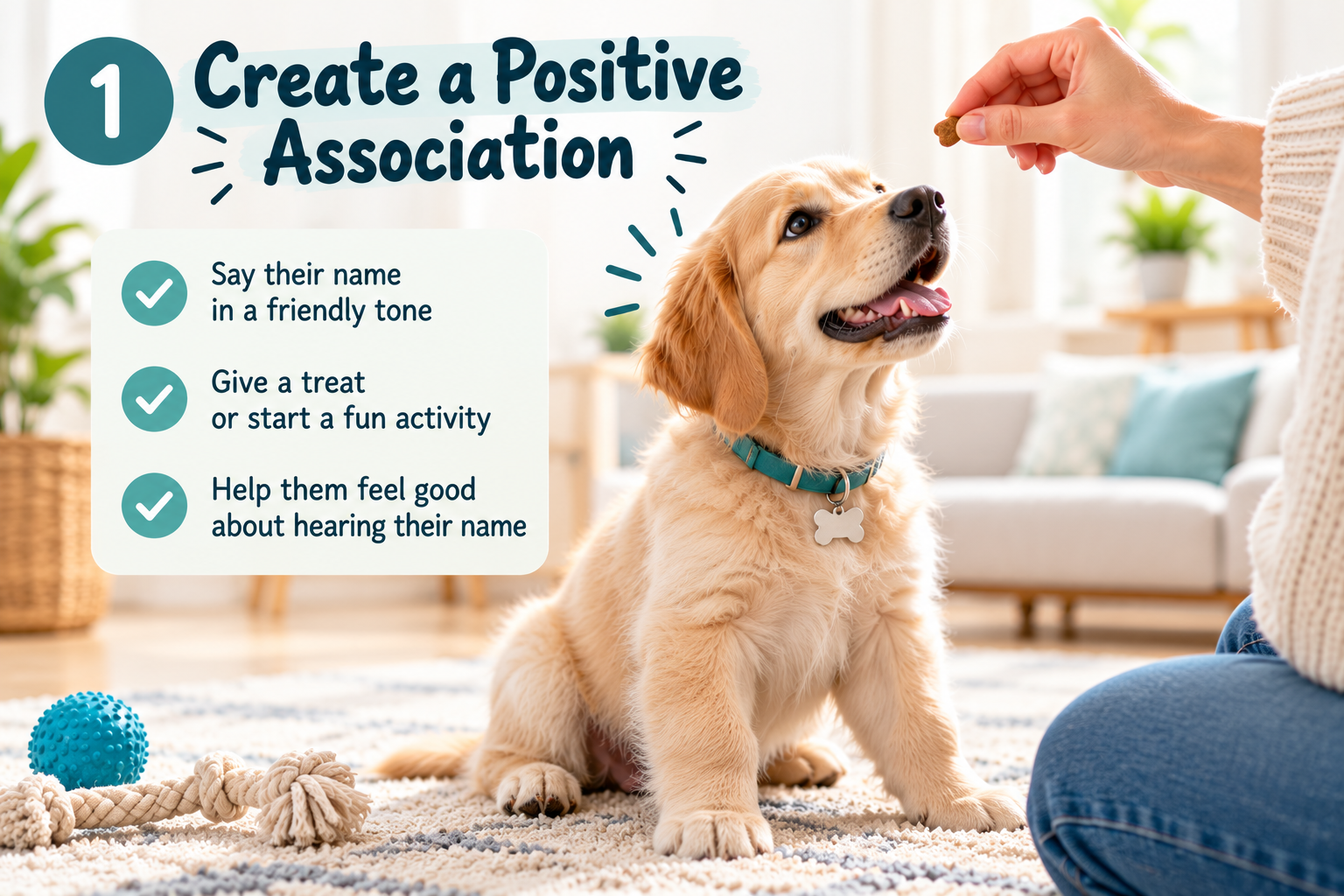
Make your dog’s name predict good things
Try saying your dog’s name during enjoyable moments, such as before giving a favorite toy, starting a game, offering a treat, or praising calm behavior.
2. Stop Repeating Your Dog’s Name Over and Over
Have you ever done this?
“Bella!”
“Bella!”
“Bella, come here!”
“BELLA!”
It’s a common habit, especially when you’re distracted or in a hurry.
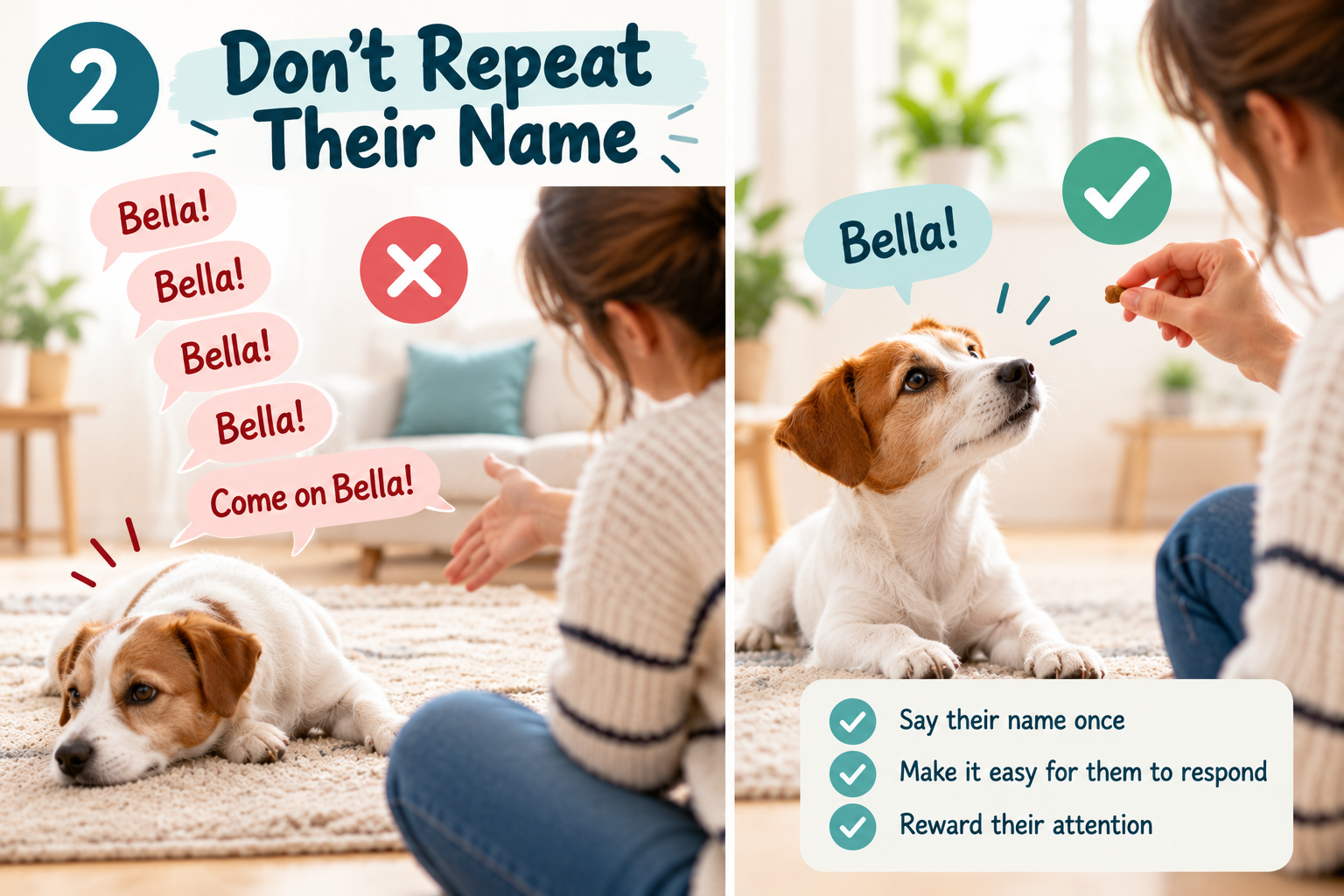
But constantly repeating a dog’s name without a meaningful response can make the sound less useful as an attention signal.
Try the one-name attention exercise
Start in a quiet room with minimal distractions.
- Have a few small, dog-safe treats ready.
- Wait until your dog is looking away.
- Say their name once in a friendly, natural voice.
- When they turn toward you, immediately say “Yes!” and give them a treat.
- Allow them to look away before trying again.
Practice five repetitions, then take a short break.
If your dog doesn’t respond, don’t keep repeating their name. Reduce distractions, move closer, or use a gentle sound to help them succeed before trying again.
What if your dog still ignores you?
You may be asking for too much too soon.
A puppy who responds beautifully in the living room might struggle in a busy park full of smells, people, and other dogs.
That’s normal.
Build attention skills gradually, starting with easy environments before practicing around distractions.
3. Use Your Dog’s Name and Nicknames With a Purpose
Does your dog have more than one name?
Maybe your Labrador is officially named Charlie, but at home you call him Charlie Bear, Charly, or Fluffy.
Many dogs can learn to recognize multiple familiar words or nicknames when those sounds are used consistently.
You can use this to make everyday communication clearer.
Formal names and casual nicknames
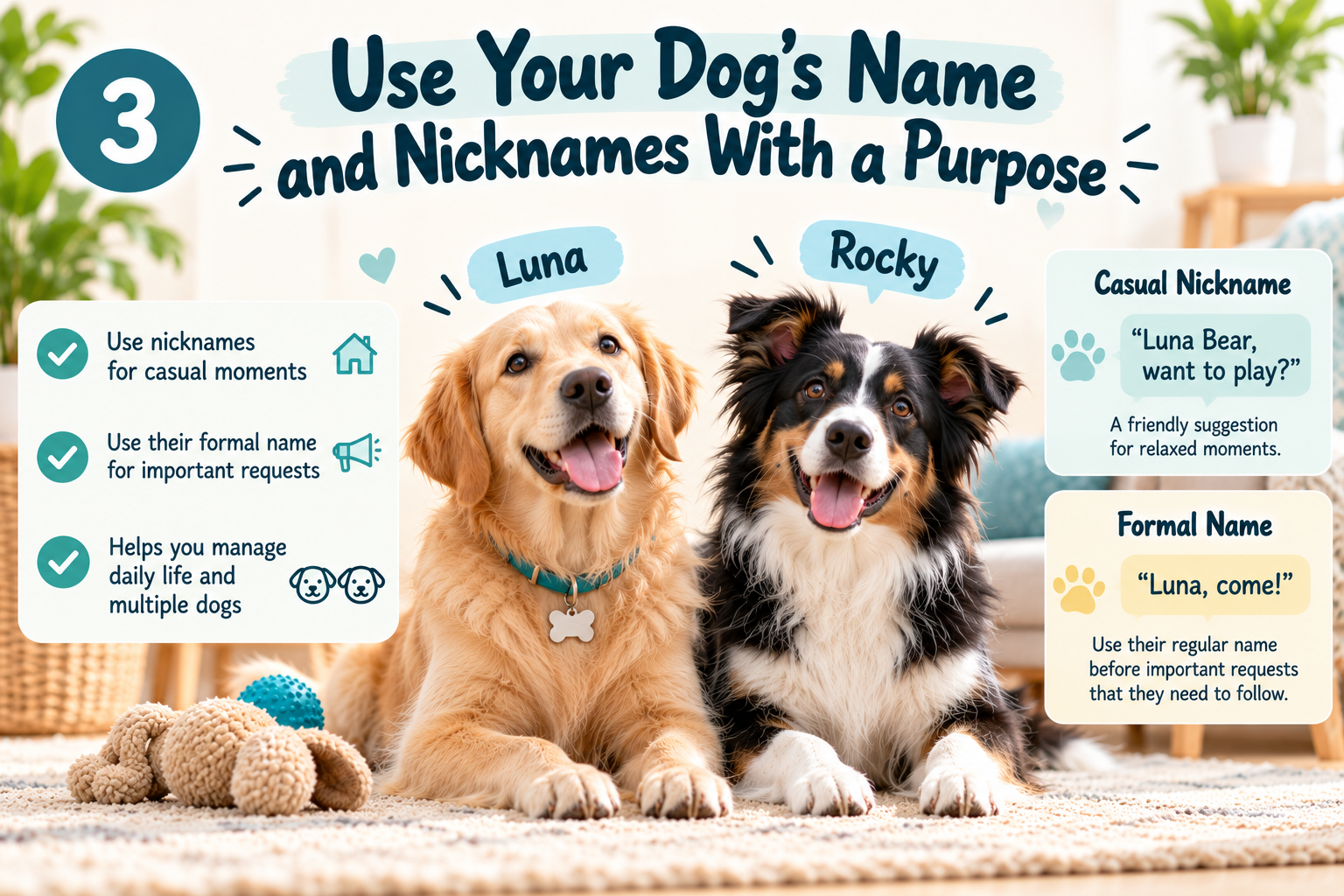
One optional approach is to use a nickname during relaxed interactions and your dog’s regular name before trained requests.
For example:
Casual moment: “Charlie Bear, want to come sit with us?”
Training moment: “Charlie, come!”
However, dogs don’t automatically understand that a formal name means a command is more important. This distinction must be taught consistently, and the cue itself needs training.
For most families, the simplest approach is to choose one reliable attention name and use nicknames mainly for affection and play.
What about homes with multiple dogs?
If you have two dogs named Luna and Rocky, teach each dog to respond individually.
Say “Luna,” reward Luna for looking toward you, and practice separately with Rocky.
Once both dogs understand their names, practice with them together.
This can help you get one dog’s attention without always calling both.
4. Teach Your Dog to Respond When Your Voice Sounds Urgent
Sometimes, getting your dog’s attention becomes especially important.
Imagine your dog is moving toward an open gate or running in the direction of a busy street.
You may naturally raise your voice.
Ideally, your dog should recognize that a louder call is still an opportunity to respond, rather than something to fear.
Practice with different voice levels
In a safe, enclosed environment, try this simple exercise:
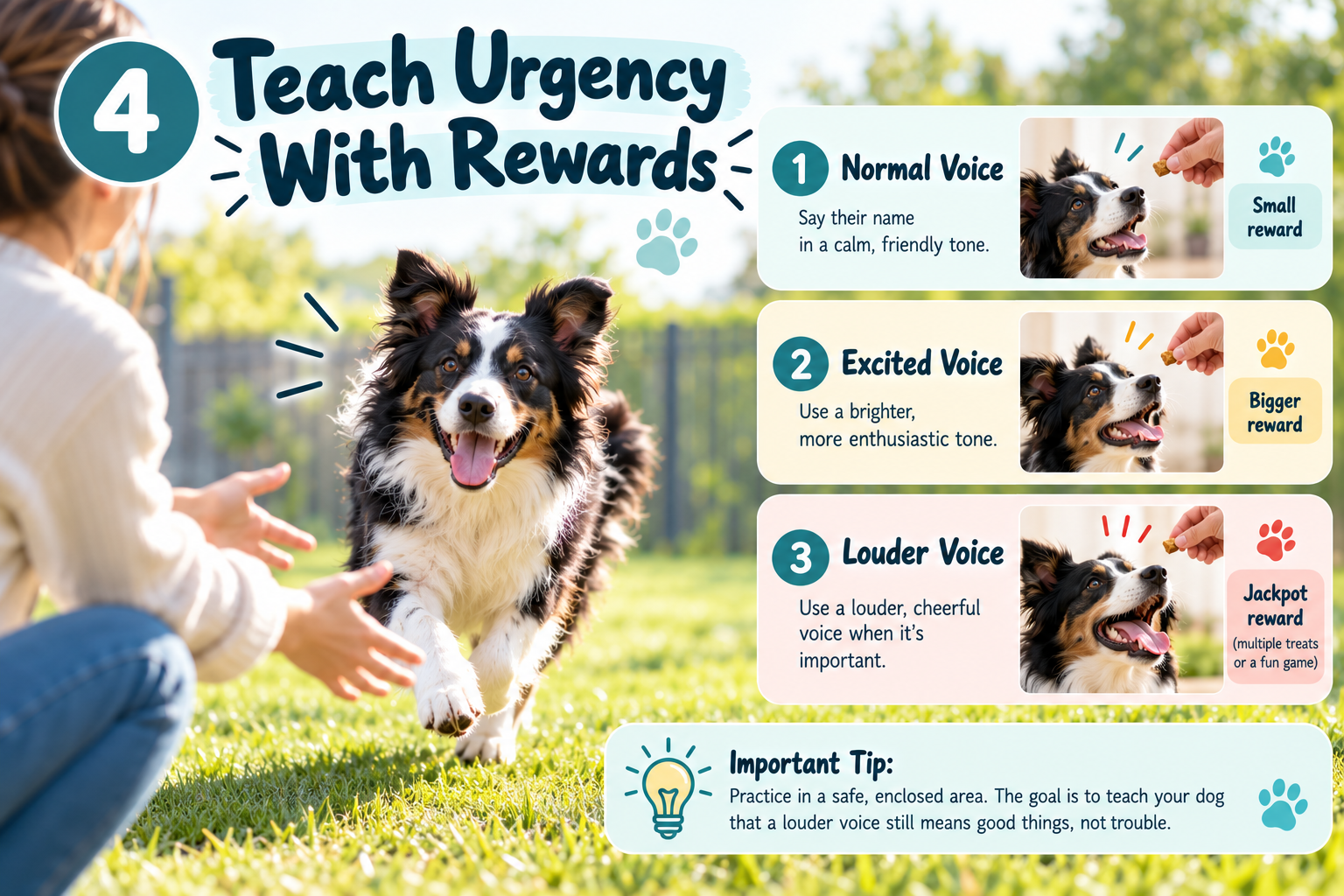
Level 1: Normal voice
Say your dog’s name normally. When they look toward you, offer a small reward.
Level 2: Enthusiastic voice
Use a slightly more excited tone and reward their attention with a favorite treat.
Level 3: Louder, cheerful voice
Once your dog is comfortable, practice a louder call followed by an especially enjoyable reward, such as several small treats or a brief game.
Keep the exercise positive. Never frighten your dog deliberately or shout directly into their ears.
The goal is to help your dog remain confident when your voice changes.
Important safety reminder
Name recognition alone is not enough for emergency situations.
Teach a separate, reliable recall cue such as “Come!” and practice it with gradually increasing distractions.
Never depend on an untested recall response near roads, traffic, or other serious hazards. Use a leash, secure fencing, and appropriate supervision.
5 Common Mistakes Dog Owners Make
Even well-meaning owners can accidentally make name training harder.
Here are five mistakes worth avoiding.
| Mistake | What to do instead |
|---|---|
| Repeating the name constantly | Say it once and make the exercise easier if needed |
| Shouting the name angrily | Build positive associations |
| Practicing only when distracted | Start in a quiet environment |
| Calling the dog only to end fun activities | Sometimes call, reward, and let them return to playing |
| Expecting immediate results | Practice consistently at your dog’s pace |
One especially important tip is to avoid using your dog’s name only when something enjoyable is about to end.
If your puppy hears their name exclusively before bath time, leaving the park, or going into a crate, they may become less enthusiastic about responding.
Mix in plenty of enjoyable interactions.
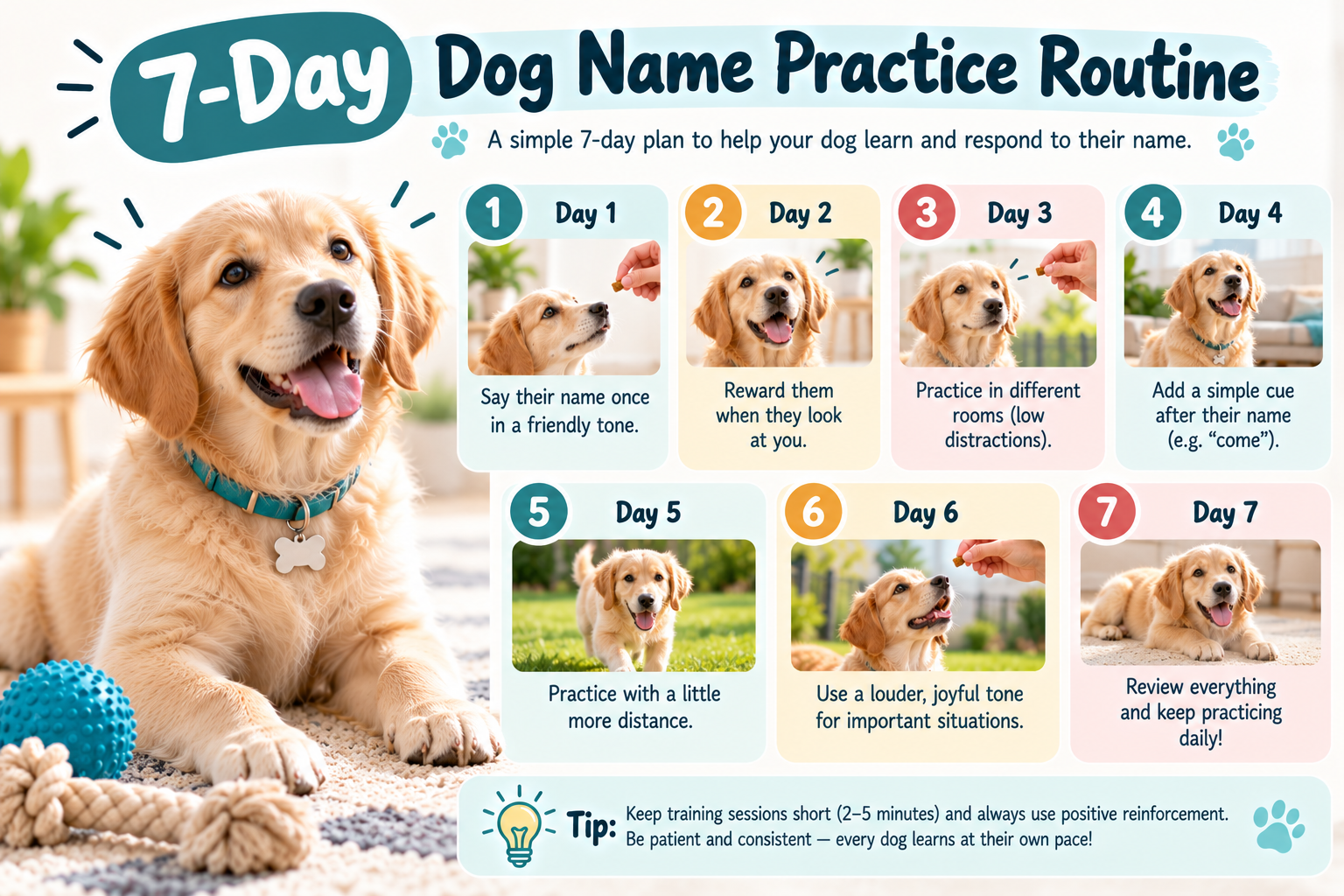
A Simple 7-Day Dog Name Practice Routine
You don’t need long training sessions.
For many puppies and adult dogs, several short, successful sessions throughout the day can be more productive than one long session.
This seven-day routine is a starting point, not a promise that every dog will master their name within a week.
| Day | Training activity |
|---|---|
| Day 1 | Practice responding to their name in a quiet room |
| Day 2 | Reward quick head turns toward you |
| Day 3 | Practice in another familiar room |
| Day 4 | Add mild household distractions |
| Day 5 | Practice in a securely enclosed outdoor space |
| Day 6 | Practice with another person nearby |
| Day 7 | Review progress and repeat exercises that need more work |
Keep sessions around two to five minutes, depending on your dog’s attention and comfort.
If your dog struggles on a particular day, return to an easier exercise. There’s no need to rush.
Some dogs may need several weeks or longer to respond reliably, especially in distracting environments.
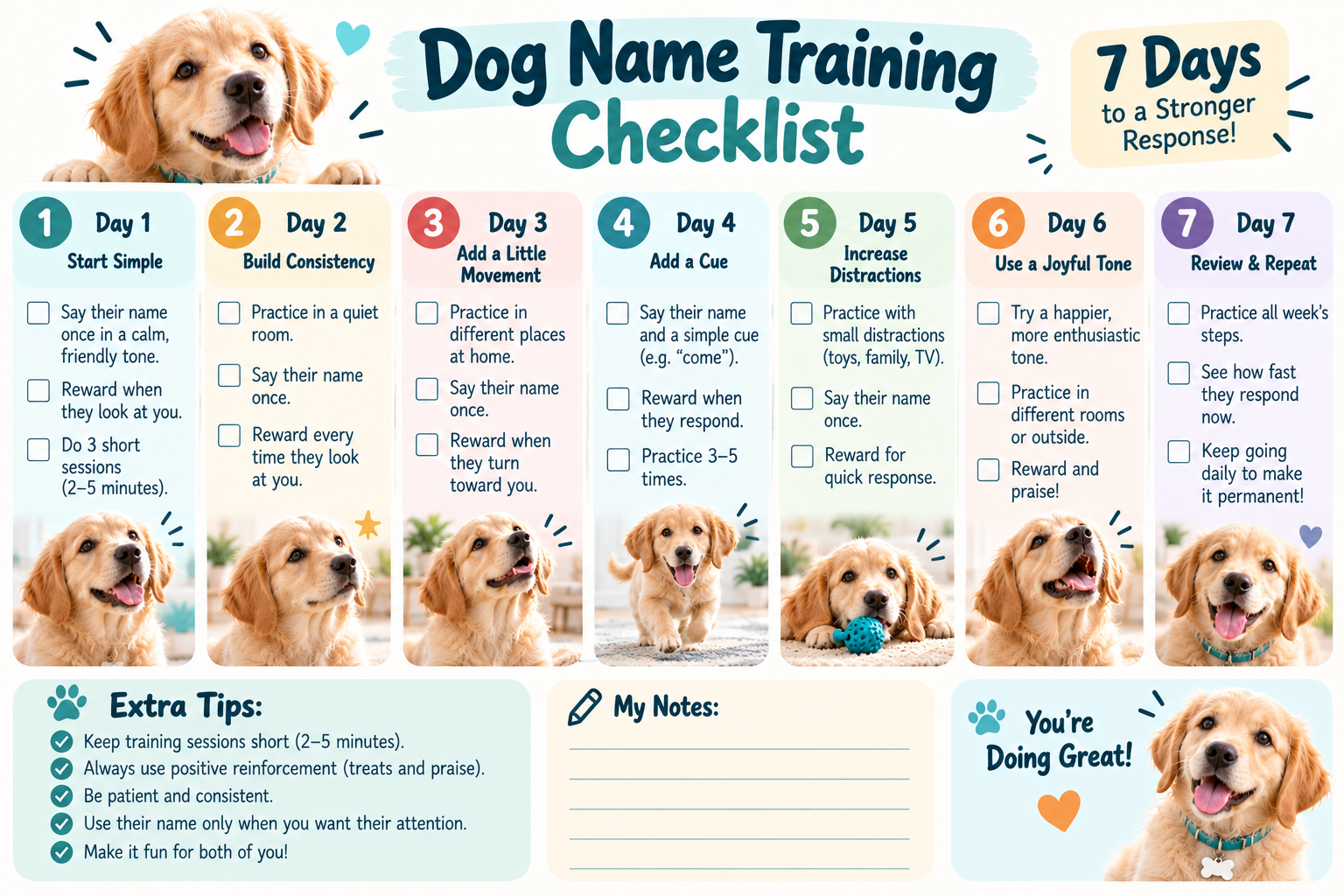
Free Printable: Dog Name Training Checklist
Want an easy way to track your puppy’s progress?
We’ve created a simple dog name training checklist you can print and use at home.
The worksheet includes:
- Seven daily practice sections
- A space to record your dog’s name
- Checkboxes for successful attention exercises
- A section for distractions and training notes
- A small space to celebrate your dog’s progress
Download Free Dog Name Training Checklist (PDF)
The printable is designed for home use and can be printed on A4 or US Letter paper.
How to Print Your Checklist
- Download the printable PDF.
- Open the file on your phone or computer.
- Select A4 or US Letter paper as appropriate.
- Choose “Fit to printable area” if required by your printer.
- Print the worksheet and start tracking your dog’s progress.
You can also keep the worksheet in a puppy training binder.
Frequently Asked Questions
How long does it take a dog to learn its name?
Some puppies begin recognizing their names after a few short training sessions. Others need days or weeks of consistent practice. Reliable responses around distractions generally take longer.
Should I change my dog’s name if they don’t respond?
Usually, no. First, try rebuilding positive associations with the existing name. If you’re adopting a dog or changing their name for another reason, dogs can learn a new name through consistent training.
Can dogs learn more than one name?
Yes. Many dogs can recognize several familiar words, including nicknames, provided those sounds are used consistently and associated with meaningful experiences.
Should I say my dog’s name before every command?
Not necessarily. Use the name when you need to get their attention. Once your dog is already focused on you, you can give the trained cue directly.
Why does my dog respond at home but not outside?
Outdoor environments have many more distractions, including unfamiliar smells, sounds, animals, and people. Practice gradually in increasingly challenging environments rather than assuming your dog is deliberately ignoring you.
Is it okay to raise my voice when calling my dog?
In an emergency, you may need to call loudly. However, routine training should use a positive, comfortable tone. Practice recall and attention skills safely before relying on them in more difficult situations.
More Helpful Dog Naming Resources
Choosing a name is only the first step. Helping your dog recognize and respond to that name is just as important.
Explore more dog naming ideas and puppy resources on Olei.net:
- How to Teach a Puppy Its Name — A beginner-friendly training guide.
- 120 Male Dog Names — Find a name that fits your new puppy’s personality.
- Unique Female Dog Names — Discover beautiful and unusual names for girl dogs.
- 50 Cute Girl Dog Names — Sweet naming ideas and printable coloring pages.
Final Thoughts
Your dog’s name should be a positive, familiar sound that encourages attention and connection.
You don’t need complicated equipment or hours of training.
Start by using their name kindly, avoid unnecessary repetition, reward their attention, and practice in situations where they can succeed.
Most importantly, be patient.
A dog’s name becomes more useful through consistent, positive experiences—not simply by saying it louder or more often.
With regular practice, you can build better communication and make everyday life with your dog easier and more enjoyable.
What is your dog’s name, and do they have a funny nickname? Share your favorite in the comments!
More Ways to Enjoy Life with Your Dog
Discover helpful dog-naming guides, creative inspiration, and thoughtful finds for dog lovers.
More Dog Name Inspiration
Explore more guides and ideas to help you find the perfect name for your best friend.
How to Choose a Unique Dog Name: A Creative Guide for Your New Best Friend
How to Choose a Unique Dog Name: A Creative Guide for Your New Best Friend Choosing a name for…
Read Article
Can You Change a Dog’s Name? How to Rename Your Dog Without Confusing Them
Can You Change a Dog’s Name? How to Rename Your Dog Without Confusing Them You’ve just welcomed a dog…
Read Article
Should You Give Your Dog a Human Name? Pros, Cons & Funny Examples
Should You Give Your Dog a Human Name? Pros, Cons & 25 Funny Ideas Imagine walking through a quiet…
Read Article
Dog Name Lab
Explore name ideas, discover different naming styles, and find inspiration for your dog’s perfect name.
Explore Name Lab
The Olei Shop
Discover dog-inspired products, thoughtful gifts, and fun finds for you and your four-legged companion.
Explore the Shop